
185
After putting in his time behind the wheel of what Markus Breitschmid dubs “the ugliest car in the world”, a Ford Mercury with chipped paint and erratically non-functioning air conditioning, he moved on to a Ford Explorer, Volkswagen Jetta and a VW Golf.
“I am an architect and value objects that are well made,” he declares. ”Many car experts argue that Porsche Carrera 911s are the best made cars ever. I could not afford a Porsche with my salary, so, I started saving for it.” He knew it probably would be one-time splurge.
“The plan is to keep the Porsche for as long as I drive. However, my mom makes fun of me saying that at some point I will not be able to get in and out of such a low-lying car. We will see,” he muses, citing a statistic that 70% of Porsches manufactured since 1948, when the first Porsche car was built, are still in use. “Nobody in a right mind would discard a Porsche.”
Purchase Process
While he could have gone to a dealership to buy a Porsche on display, Breitschmid is quick to say: “That is not really the proven way to purchase a Porsche.” So he visited the company’s headquarters in Weissach, Germany in May of 2008 and ordered a basic Porsche 911 Carrera, minus most of the hundreds of options available.
Essentially, a Porsche is a driving machine and not a fluffy carriage, he’ll say, querying who really needs accoutrements like rear window wipers? “When one drives a Porsche, the rear window rarely gets wet. In my view, the best Porsches are those with minimum equipment.”
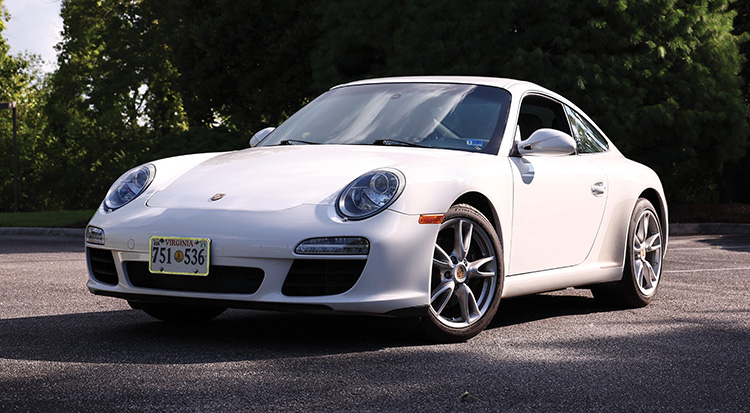
His basic – like whatever is “basic” about a Porsche? – white sports car with gray leather and Alcantara® interior was delivered to him in the U.S. seven months after he ordered it. Alcantara® is a luxury suede-like microfiber product often used in car interiors.
Porsche 911 Carrera
– a very sexy car
Breitschmid’s Porsche has a manual transmission. “It offers the maximum driving experience, much more exciting,” he offers, “even though the newest gear shifting technology adopted from Formula 1 is faster than a human being ever could shift gears.”
The trunk is in front, and the engine is in the back. It is a hallmark of Porsche Carrera 911s that their engines are in the back. It is a so-called Boxer (Flat) Engine which differs fundamentally in cylinder arrangement from other types of engines such as V-8 engines or inline engines. “The advantage of Porsche’s flat, 6-cylinder engine is an extremely low profile providing a low vehicle center of gravity for better handling and balance and limiting vibration,” he explains.
“The cylinder arrangement requires a significantly wider layout. This is the reason Porsche 911 has that fantastic, curvy-looking ‘behind’. Porsche 911s are very sexy cars. My version of the Porsche is equipped with a 3.6 liter, water-cooled, flat-6 naturally aspired induction with direct fuel injection. It produces 345 horsepower at 6,500 rpm and a torque of 287-288lb-ft @ 4,400 rpm. Because the car is built out of aluminum, it is very light in weight.
Design and Speed
With regard to ergonomics and overall design, Breitschmid states: “I have never seen a better designed air-conditioning system anywhere. These German engineers figured out the airflow so perfectly that the car has the perfect cabin temperature, yet one does not feel any draft whatsoever.”
This Porsche could go up to 200 miles per hour and, of course, anyone who buys a Porsche is unconcerned with miles per gallon. “It would be a bad idea for me to try to drive that fast for various reasons – lacking the driving skills and a racetrack notwithstanding.” Perhaps a small downside could be the $800 oil and filter change and $750 per tire cost. But hey, the superior quality things of life come with a price tag and deliver in spades on wonder, satisfaction, pleasure and treasure.
Breitschmid revels in pure joy and a most magical experience driving his Porsche 911 Carrera (which means racing in Spanish). “What I like about it most is that it is a fantastically well-constructed car and a beautifully-designed object,” he concludes.
Text by Joanne M. Anderson | Photos by Jon Fleming
