
157
You know what goes well with a seasonally-trendy, steamy, pumpkin latte? A chilling tale of untimely death! Just what makes a good ghost story stick? Jimmy Smith, host of the Spooky Appalachia podcast and YouTube channel, says, “I honestly think it’s the stories that are passed down from generation to generation.”
The Lyric Theater
Blacksburg’s downtown theater was the third in the Commonwealth to show “talkies” (movies with sound), and it’s one of a few historic theaters that still has a balcony. It also has ghosts! Executive director Seth Davis told Smith in a Spooky Appalachia interview: “One of our front-of-house managers was getting ready to clean when the film had ended and saw an older couple watching the credits. She decided to come back in a few minutes, and when she did, nobody was there.”
Perhaps the most well-known haunter is a construction worker who fell to his death while building the theater. Visitors have reported a strange male voice coming from the balcony and accounts of a ghost figure brushing up against movie-goers and employees.
St. Albans Sanatorium
Before it was a questionable refuge for the mentally ill, it was a questionably sound institution for learning, St. Albans Preparatory School. Disciplinary tactics were particularly harsh, and the overall environment was severe and menacing.
In 1916, St. Albans reopened as a sanatorium with no healthier a vibe. Treating the mentally ill at the time was violent. The facility closed in the 1990s. The ominously dreary building faced demolition around 2010, but local historians and paranormal groups insisted on its preservation. Now it’s available for private tours (some by flashlight), so the public can hear agonizing screams, see empty wheelchairs moving, and feel small hands of invisible children.
The Black Sisters
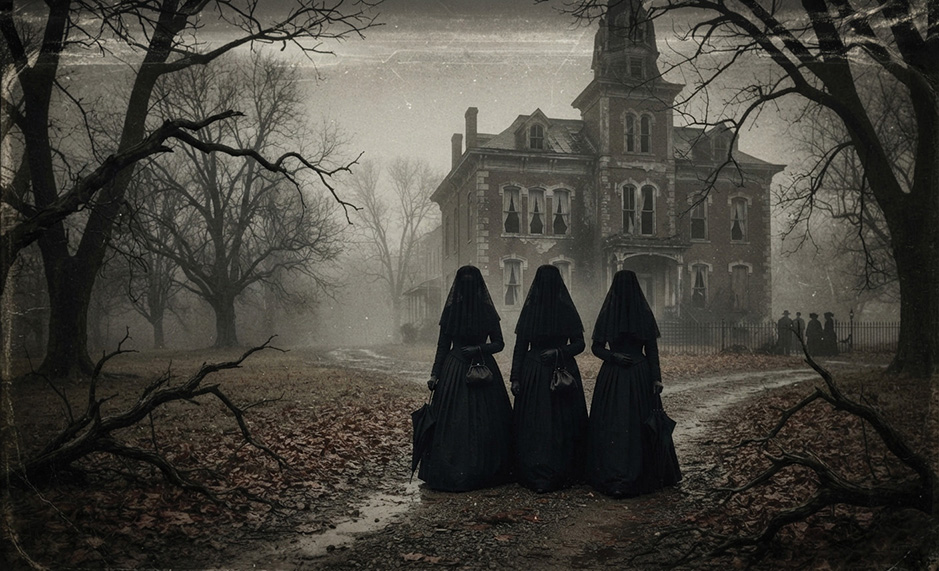
But the best, most enduring cream of the creepy crop? “Without a doubt it is The Black Sisters,” Smith declares. “That whole story, with or without the alleged haunting stories, is terrifying! You’ve got three sisters strolling around town in all black, going to Sunset Cemetery, performing rituals at night, and all the murders and mayhem.”
In the early 1900s, Virginia Wardlaw took over the faltering but once well-respected elite Montgomery County Female Academy in Christiansburg. When she summoned her sisters, Caroline Martin and Mary Snead, to join the faculty, the halls darkened. An article on montgomerymuseum.org includes: “Described by family as ‘insane for years,’ Caroline dressed in black with veils and isolated the family. She disrupted operations by changing classes, padlocking doors, frightening students.”
Caroline coerced her nephew, John Wardlaw Snead to join the staff. John Snead “fell” off a moving train and survived. He was found nearly drowned in the school’s well and survived. He perished when his clothing was doused in lamp oil, and he caught fire. A large, uncommon-at-the-time, life insurance policy had been taken out, benefiting his Aunt Virginia. Local suspicion and associated headlines were aflame.
After the sisters left Virginia in 1908 and in 1909 for New Jersey, a niece was found drugged and dead in a bathtub, with a life insurance policy benefiting her aunts. The sisters were arrested for murder. Virginia starved herself to death awaiting trial. Mary was acquitted on technicalities. Caroline was committed to an insane asylum and died there in 1913.
The sisters in black haunt the halls of the Montgomery County Public Schools building on the site of the old female academy. People have shared disturbing stories of encountering them. Dark figures darting away at the end of empty hallways, a lady’s voice whispering and chanting at people outside to come in and find them, sinks coming on in the bathrooms spontaneously, three black-clad women floating along the adjacent sidewalk. Boo!!
National Fame:
The Headless Horseman.
From the pages of Washington Irving’s 1820 short story, “The Legend of Sleepy Hollow,” schoolmaster Ichabod Crane was simply out to court the lovely Katrina van Tassel. Ultimately, she turns him down, and Crane is run out town when a headless man on a horse – either a [living] rival suitor in disguise or a [dead] Hessian soldier missing his head due to a cannonball – hurls a jack-o-lantern, often depicted on fire, at Crane. The rejected teacher is never heard from again.
In a 2025 article on history.com, historian Elizabeth Bradley states that America’s first renowned ghost story endures with readers because “it reminds them that there are still some American mysteries, some half-truths that may never be fully known – and that’s the whole point. The ‘Legend’ lends itself to any interpretation, and it continues to fascinate and terrify us in the best possible way.”
But what about the headless horseman’s horse? Why do Crane and the beheaded equestrian get all the fame and glory? If the headless horseman is, in fact, the winning suitor, the horse’s name is Daredevil and likely lived a full, normal life. Alternately, if the dead soldier’s spirit is riding the chasing steed, the nameless horse is said to be forever searching the night for his owner’s missing head. Doomed for eternity.
The Local Angle. The next time you are out strolling the trails at Pandapas Pond, and the sun sets before you get to the parking lot, keep a keen eye out. New York’s most infamous, devout, four-legged detective may approach to inquire about a spare head. Maybe consider having one at-the-ready. Mwah ah ah!!
Text by Nancy S. Moseley
Nancy S. Moseley is a writer from Blacksburg. She only agrees to attending haunted houses when peer pressured. And only then when she’s promised a seasonally-trendy nerve-calming pumpkin beer afterward.
