
549
Of more than 10,000 mushroom species, about 2,000 are edible. Of those, a couple dozen are commonly cultivated for consumption, and the most popular are portobello, cremini, button, shiitake and oyster varieties. They are low in fat and calories, and high in several of the B vitamins, along with vitamin C, selenium, trace minerals and offer a modest amount of fiber.
They vary widely in shape, size, color and habitat. Some are tiny and nearly invisible to the naked eye, while others, like giant puffballs, can grow to the size of a soccer ball. Their forms can be equally varied, ranging from the classic umbrella-shaped cap and stem to coral-like structures, shelf-like brackets, and even bioluminescent varieties that glow in the dark.
For the foodie, mushrooms are incredibly versatile and bring distinct flavors and textures to different foods and methods of preparation. Some are mild and tender, others are rich and earthy. For vegetarians, they can be an alternative to meat due to a dense texture and savory taste. For folks cutting out caffeine, mushroom coffee is an option.
Mushroom 101
Mushrooms are among the most fascinating and diverse organisms on Earth, occupying a unique position in the natural world that blurs the boundaries between plants, animals and microorganisms. Though often overlooked or misunderstood, mushrooms play essential ecological roles, possess remarkable biological properties, and have deep cultural, culinary and medicinal significance.
At their most basic level, mushrooms are the fruiting bodies of fungi, a kingdom distinct from plants and animals. Unlike plants, fungi do not perform photosynthesis. Instead, they obtain nutrients by breaking down organic matter in the environment. The visible mushroom is only a small part of a much larger organism that exists primarily underground or within its food source as a network of thread-like structures called mycelium. This mycelial network can stretch for vast distances, even acres, making certain fungal organisms among the largest living entities.
Ecologically, mushrooms are indispensable. They serve as nature’s recyclers, decomposing dead plants, animals and other organic material into simpler compounds that enrich the soil. Without fungi, ecosystems would quickly become overwhelmed with waste, and nutrients would remain locked in unusable forms. This decomposition process supports plant growth and maintains the balance of ecosystems
Captivated by Mushrooms
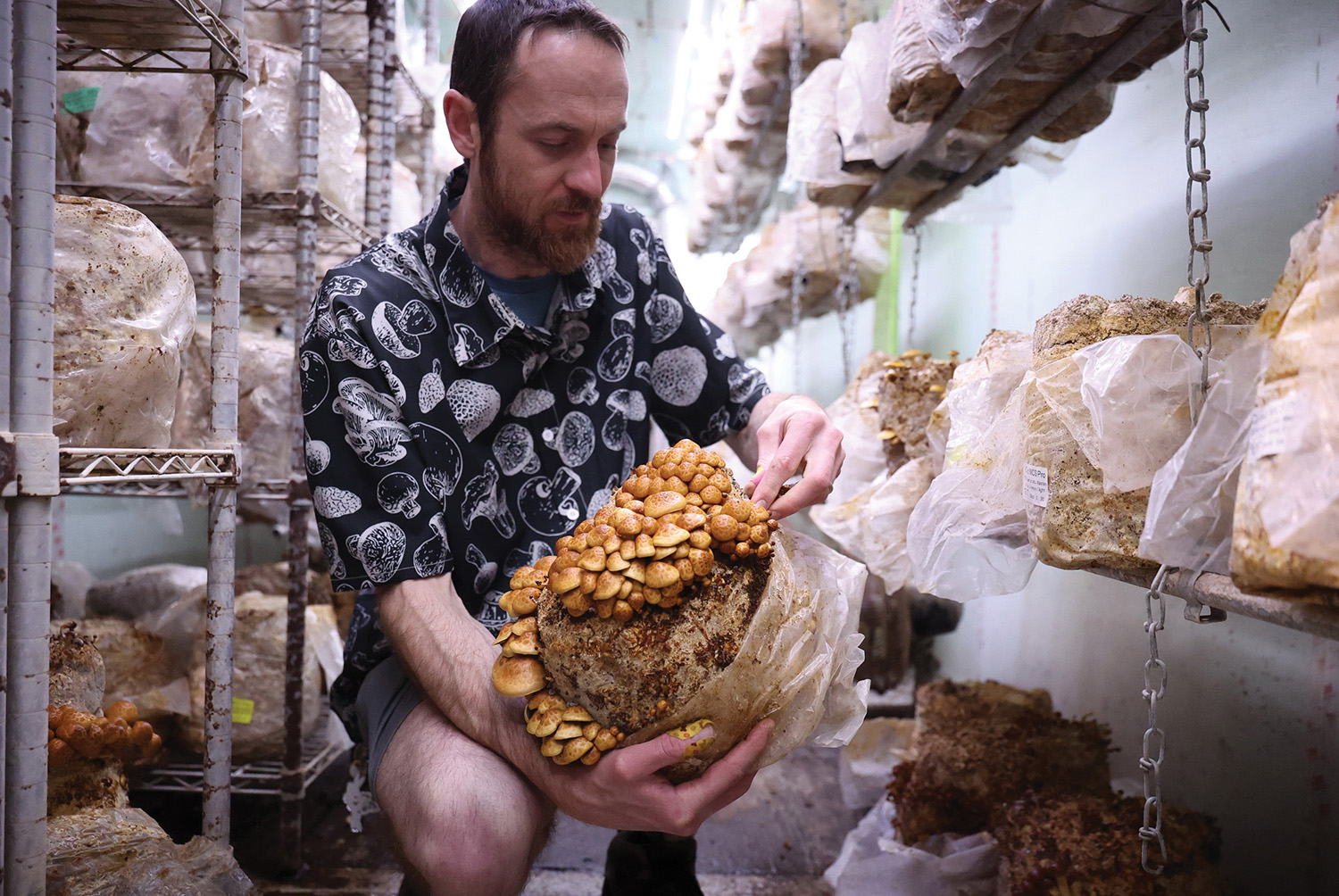
Blacksburg native Ben Harder enjoyed cooking and eating mushrooms, as well as growing vegetables and herbs on his farm, Den Hill Permaculture (now Den Hill Farm and Fungi), established in 2012. After meeting an Appalachian Trail hiker at the Blacksburg farmer’s market, things changed. The hiker was selling fruiting shiitake mushroom logs to fund his trek, and Harder was simply fascinated.
He expanded his farming endeavors to include growing three kinds of mushrooms. As his passion for these amazing organisms mushroomed, he and wife Jackie and the team at his farm moved to a more sophisticated approach. He designed a climate-controlled fruiting chamber and a spawn production lab in a very large old shipping container, think of an extra-large POD. It’s an impressive creation with four to six inches of insulation all around. Inside, Harder has intricate control mechanisms for humidity, air flow and heat and can grow 1,000 pounds of mushrooms a month, in individual bags, year round.
You can see, touch and buy Harder’s mushrooms at the Blacksburg farmer’s market every Saturday, or order online in advance. He is offering a new Gourmet Culinary Mushroom Log Workshop where you can choose what type of mushrooms you want to grow, including shiitake, oyster, comb’s tooth and chestnut. Check the website for dates and times.
Innovation with Mushrooms
In recent years, mushrooms have attracted attention for their potential in sustainability efforts. Mycelium, the root-like network of fungi, is being explored as a biodegradable alternative to plastics, packaging materials and even leather. Its ability to grow quickly and bind organic matter makes it an environmentally-friendly resource for a wide range of applications. Scientists and entrepreneurs are investigating how fungal materials can reduce waste and provide sustainable solutions to global challenges.
Mushrooms are fascinating and far more than simple forest growths or culinary ingredients. They are vital components of Earth’s ecosystems, remarkable organisms with unique biological features, and valuable resources for food, medicine and sustainable technology. As scientific understanding of fungi continues to expand, mushrooms are increasingly recognized not just as curiosities of nature, but as key players in the future of environmental health and human well-being.
Text by Joanne M. Anderson
Photos by Jon Fleming
Photos by Jon Fleming
Hardermushrooms.com
New River Valley Mushroom Club
[on Facebook]
