
781
Back in 2011, Matt Damon bought a zoo. Not a real one, of course, but one for entertainment purposes, courtesy of Hollywood.
And in 2003, Sarah and Cedric Shannon bought a farm. It was a very real one (or would slowly grow into one) tucked in Floyd County, a galaxy far, far, away from Hollywood.
Both Sarah and Cedric grew up overseas, she in Jordan and he in the Congo. They met in college in Illinois over a shared childhood that didn’t include growing up in America. A wedding and five children later, they were ready to abandon suburban life for something a little more open-air.
“One year when we were visiting family in Roanoke,” Cedric says, they decided to visit some farms in Floyd. “The very first farm we visited was our neighbor here, and he told us: ‘There’s a farm for sale next to me, you should check it out!’”
“We weren’t ready to buy a farm,” Sarah laughs, “but we ended up buying a farm.”
The Family Move from Illinois
Sarah’s brother, his wife and a few other friends, six in total, invested in the farm, but the Shannons are the only ones who relocated. They own 60 acres and operate on 200, renting the difference. Their oldest child was seven and the youngest was 9 months old when they left Illinois. “Our daughter remembers very little other than the chaotic long drive down here, traveling with our rabbits. The kids loved being outside and having so much space to explore.”
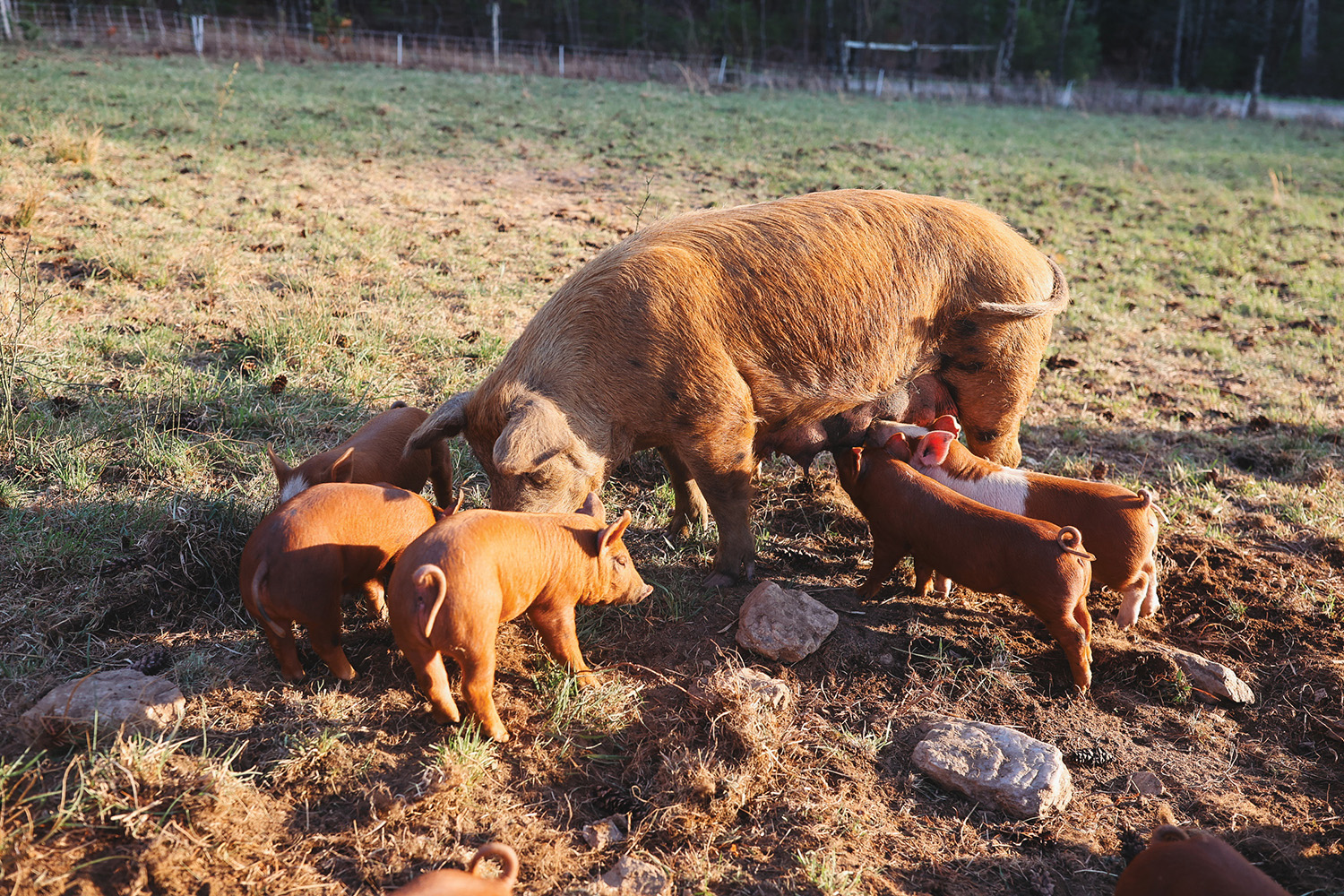
Sarah emphasizes the farm grew slowly, but steadily and intentionally. “We started very small and grew our farm very slowly. We just had a couple hundred meat birds the first year, some laying hens, a few turkeys, and then the next year we added some hogs. Each year we added a little more. Our markets, I’d say, also grew very slowly, but it was able to build organically, mostly by word of mouth.”
The first few years both Sarah and Cedric worked part-time off-farm and lived in a mobile home until they could build a house. Now, Weathertop Farm (named for both the voracious wind and a beloved Tolkien reference), is a thriving farm with operational practices rooted in sustainable agriculture.
Sustainable Agriculture at the Core
“After we finished college,” Sarah says, “we started learning more about sustainable agriculture. The more we learned, the more we got excited about that and knew it was something we wanted to get involved with.”
In regenerative agriculture circles, soil is the key ingredient. The development of farming on a global, industrial scale has been a detriment to soil health. The invention of the plow left soil eroded and depleted due to exposure to the air. For soil to be healthy and productive, it needs to always have something growing on it, with the ideal situation to have something eating it as well. Cattle or sheep or other animals should graze and then move on to let the land recover. Because of all the natural fertilizer from the animals, the grass will grow back stronger and healthier, then a different animal will take ownership, to maximize the benefit of biodiversity. The best way the Shannons found to manage the movement of animals is to use electric fencing.
All the animal shelters and housing are on skids and portable with the use of a tractor. “We just hitch up to a chain, pull the [animal] house forward, move all the food and water forward, and then we close the electric paddock behind them. That area gets a rest for a while,” Sarah explains.
“We’ve been able to see our grass really improve, and as you see that improve, you know that the soil is improving underneath. When you see grass is growing better and healthier and thicker and more diverse, you know that the soil is also doing its job.”
Weathertop Farm doesn’t use antibiotics, hormones or chemicals, or any chemical fertilizers, sprays or insecticides, all to maintain the closed loop system as much as possible.
The Sales Side and the Roots
The farm is open to the public twice a week for patrons to shop, and once a year they host an “open farm” day offering tours. They sell to Annie Kay’s in Blacksburg, Harvest Moon in Floyd and the Roanoke Co+op, and have weekly booths at both the Blacksburg and Floyd farmers markets. Every Thursday the chickens are butchered, and customers are welcome to pick up their order that same afternoon.
“They’ll take home really fresh chicken; they’ll either cook it right away or freeze it for themselves, and that’s the most economical way for them to get it from us.” The farm also sells whole and half animals for lamb, pork and beef.
“Growing up, neither of us really had roots in the U.S., and this has now become, especially when we first bought the farm, our roots, the place where all family gathers. Everyone gets together at the farm they love. Usually every summer or Christmas, all the family gathers and stays here together.”
Which is quite fitting since roots are found intertwined deep in the soil, and healthy, flourishing soil makes for the strongest, most sustainable root of all varieties … family.
Text by Nancy S. Moseley
Photos by Madison Underwood
Photos by Madison Underwood
Nancy S. Moseley is freelance writer whose favorite animal on a farm is always the farm dog, who is always lovingly protective and always pretty dirty.
