
218
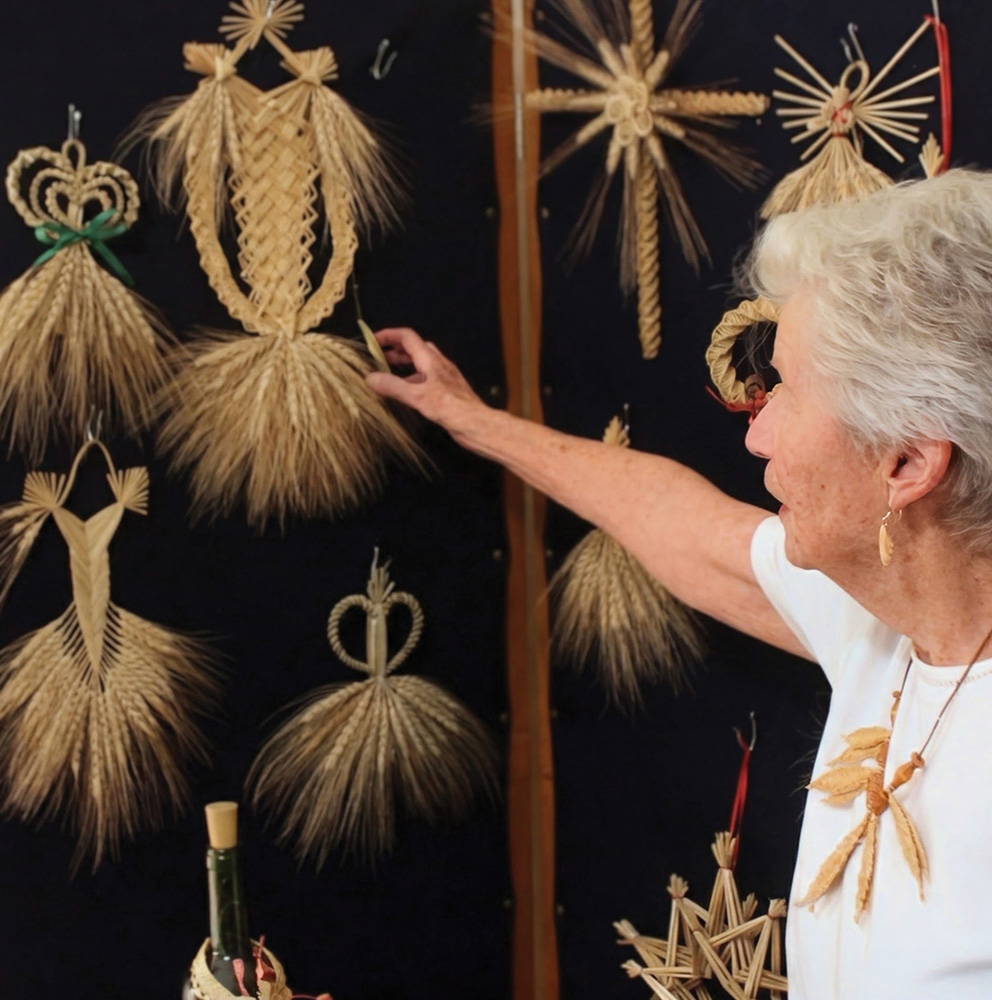
A golden barrette made from wheat adorns Debbie Warren’s silver hair. Her earrings are wheat, too, as is the delicate necklace resting below them. Across the room, the same humble material has taken considerably different forms – flowers and baskets, angels and animals, a graceful seahorse and even a miniature penny-farthing bicycle.
For Warren, a retired nurse living with her husband at Warm Hearth Village in Blacksburg, the possibilities contained within a stalk of wheat seem nearly endless. And she has spent decades exploring them.
“It’s really braiding, not weaving,” she explains, turning through one of many books that fill her workspace. The distinction is perhaps fitting for a craft that has itself braided together generations and cultures.
Long before wheat weaving became decorative folk art, straw was a useful material. In agricultural communities, what remained after the grain was harvested could become rope, baskets, hats, thatched roofs and other necessities. Over centuries, practicality and artistry intertwined, and distinctive traditions emerged across Europe and Asia.
Warren delights in their differences.
She turns pages of her books like a traveler moving from country to country. Delicate split-straw flowers and elaborate dolls from Ukraine and neighboring Eastern European traditions; intricate Swiss straw work; Japanese creations made from rice straw; English designs such as the traditional Mordiford Heart; and extraordinary geometric Lithuanian hanging structures, similar to mobiles, assembled from hollow pieces of straw threaded together.
The latter particularly fascinates Warren. “There’s a lot of engineering there,” she says, studying one of the structures. “They’ve worked it out. Just fabulous stuff.” Warren has tried her hand at that, too.
The Rhode Island Connection
Her own journey into this ancient world began in a place where wheat was hardly plentiful. Rhode Island. In the 1980s, Warren worked as a nurse while she and her husband tended a rocky hillside they purchased there. They began planting tiny Christmas trees, which were just “a penny a pop”, simply as a way to make use of the land.
The trees grew. People would buy them. Each year the Warrens planted more. Her husband, a woodworker, began making wooden toys that sold to families visiting the farm during the holidays. Warren, who already sewed and knitted, wanted to contribute something of her own. “I wanted to learn how to make ornaments.”
The answer appeared at a convention for New England Christmas tree growers, where Warren encountered a woman teaching straw ornament-making. She left with information about supplies and kits and began experimenting. Never mind that Rhode Island wasn’t exactly wheat country. From those first Christmas ornaments grew a craft Warren would practice — and teach — for decades.
Preparing Wheat
The raw material remains remarkably simple. Warren harvests wheat in June, when it has matured but the seed heads remain tight. She dries it in the sun until the stalks are stable, then “cleans” each piece by removing its leaves and trimming away the nodes. When she is ready to work, she reverses part of the process, soaking the dried stalks in hot water for about 30 minutes to make them pliable again. Her tools can be equally unassuming – heavy-duty carpet thread, scissors, water and, depending on the project, pins, cardboard, wire or a wooden form.
With a clove hitch knot securing several stalks together, the transformation begins. Three straws can become an elegant flat braid. Five can spiral into a 3-dimensional basket, ornament or hat. The braid, also known as “plait”, can expand or contract depending on how Warren manipulates the stalks. Wire wrapped in straw allows her to coax the material into sculptural forms — including that tiny seahorse. “You have to learn how to use the material itself,” Warren points out, placing uniform head lengths, colors and stem widths into piles.
Advancing Skills
Warren eventually became a regular at craft shows and attended gatherings of the National Wheat Weavers Association. She studied with accomplished artists from England, Scotland, the Netherlands, Australia and Belarus. Those lessons expanded Warren’s repertoire considerably. Wheat can be split into impossibly fine pieces, spun, braided, coiled around forms or even dyed — although the latter requires boiling it much like an Easter egg. “It’s a pain,” Warren reveals with a laugh.
Over decades of teaching, she noticed that students accustomed to working with plants — gardeners and flower arrangers, in particular — often understood wheat intuitively.
“They take to it much quicker.” Today, near Warren’s work table, a photograph of her grandmother — a quilter still piecing fabric by hand late in life — watches over a room filled with Warren’s own handiwork. Warren calls the images around her workspace her “talismans.”
There is something fitting, too, about where all those threads have led. Her grandmother worked in fabric. Her daughter studied horticulture at Virginia Tech. Warren found her medium somewhere between the two — a plant transformed by practiced hands.
These days, she has largely retired from the craft-show circuit and formal teaching, although she still shows the occasional curious visitor how it is done and participates in lower-key shows at Warm Hearth. Her studio, however, suggests little retirement from wheat weaving.
Text and photos by Emily K. Alberts
Freelance writer Emily K. Alberts loved this assignment and continues to admire the stunning wheat-woven Mordiford heart that now hangs above her doorway, a gift from Debbie Warren.
