
207
On a football game day in Blacksburg, the scene is unmistakable. A sea of fans descends on Lane Stadium, maroon and orange making up the waves. The atmosphere vibrates with anticipation. The crowd reaches earthquake levels jumping in unison to “Enter Sandman”. And our players put it all out on the line.
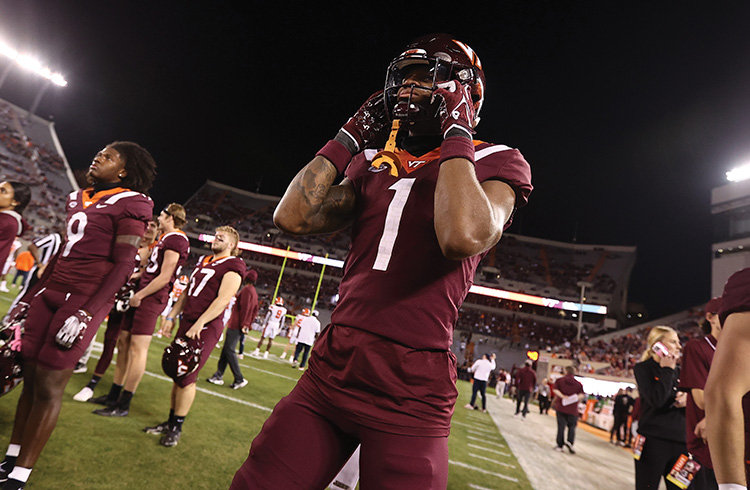
These sports events draw spectators from all over the world to Virginia Tech every fall, but there is another silent story being told on the field — one woven into the very fabric of the program. From the iconic Hokie Stone pattern on the jersey numbers to the specific hierarchy of colors on the practice field, the Hokie uniform is a blend of tradition, style and branding.
Virginia Tech’s aesthetic is one of the most recognizable in college football. While the program’s identity is anchored in its primary colors of maroon, orange, white and the distinctive Hokie Stone gray, the uniform itself is a constant evolution; one that deserves more attention.
Walk through the Merryman Center, and you’ll see different uniforms displayed on mannequins. The home jersey is almost always a deep, memorable maroon. For years, variations have cycled through, sometimes opting for a clean, minimalist look and other times embracing shoulder striping that pops with orange and white.
Perhaps the most unique element in the Hokie design depository is the Hokie Stone pattern, often highlighted in the numbers. It’s a literal nod to the architecture of the campus, a way to ensure that every player wearing the uniform carries a piece of Blacksburg with them. And then there are the gray jerseys that pay homage to that same limestone masonry, serving as a reminder that this program is built on a foundation as solid as the buildings on campus.
The Lowdown on Jerseys
When you see a player on the field, that jersey isn’t just a shirt; it is a piece of high-performance engineering by Nike. Contrary to the myth that players get a fresh jersey every single game, the reality is a massive logistical operation. These jerseys are durable, high-tech garments designed to withstand the tugging and tackling of Division I football. They are laundered, mended and re-used throughout the season.
The sizing is as much about function as it is about aesthetics. A jersey must be large enough to accommodate the massive bulk of modern protective shoulder pads, yet tailored to stay tucked in during the rigors of a four-quarter game. It has become a common trend for some players to opt for shorter, “cropped” looks or tighter fits; often a personal preference that, while may garner some criticism, benefits mobility, cooling and style.
The gear isn’t just for game day. Step onto the practice field at the end of the week, and you’ll see a visual hierarchy in motion — the offense in clean white, defense in familiar maroon, and quarterbacks standing out in distinctive orange “no contact” jerseys. It is a system that allows coaches to instantly identify players, ensuring that the chaos of practice is controlled and organized.
About Those Numbers
One of the most frequent questions from fans involves the numbers themselves. Does the team retire a number when a legend leaves? In years past, collegiate programs often retired numbers, taking them out of circulation entirely. Virginia Tech’s approach has evolved with the times. The athletics department moved away from permanently retiring numbers to avoid running out of available digits for a roster of 100-plus players. Instead, the focus shifted to retiring the player’s actual jersey; honoring their legacy while keeping the number available for future generations. It is a balance between honoring history and respecting the practical needs of the current team.
As for the sideline attire, you won’t see the coaching staff wearing game jerseys at games. While they are decked out in branded Hokie gear such as polos, pullovers and jackets, the game jersey is an exclusive honor reserved strictly for the players who strap on the pads.
As Nike continues to push the boundaries of fabric technology by making uniforms lighter, more breathable and more tear-resistant, the Hokie team look will continue to adapt. Whether it’s a return to a classic, clean design or a Hokie Stone-infused experiment, the goal remains the same — to look like a Hokie.
For the players, putting on that maroon jersey is a rite of passage. For the fans in the stands, it’s a symbol of belonging. And for the equipment managers working behind the scenes at the Merryman Center, it’s a full-time job of maintaining a legacy of a program through the fabric of Viriginia Tech football.
Text by Madi Mann
Photos by Jon Fleming
Madi Mann is a freelance writer and junior at Virginia Tech majoring in Multimedia Journalism.
