
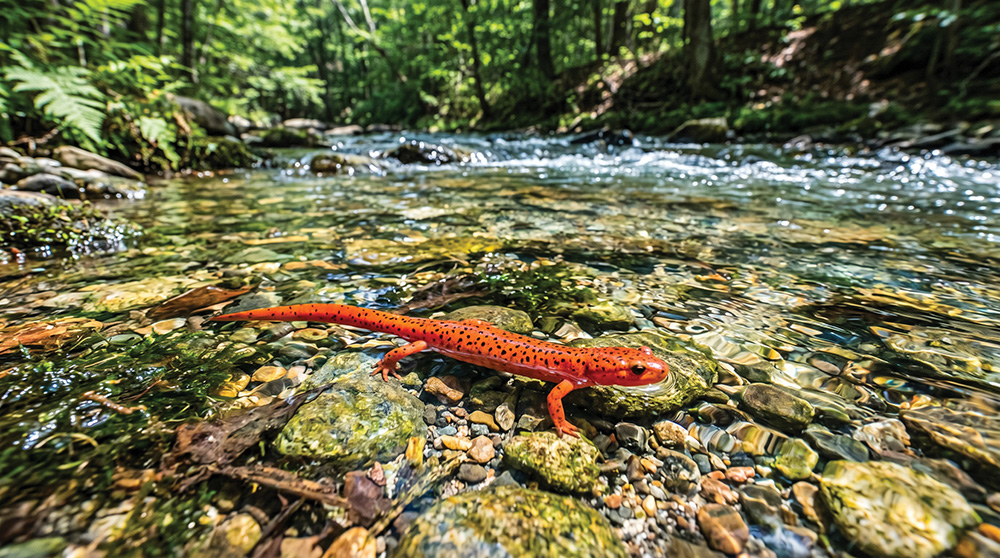
Slick and orange creatures dot the New River Valley landscape after a replenishing spring rain, bringing with them the cautionary tales of their toxicity and the debatable terms of their vocabulary (are they newts? salamanders? lizards?). The legendary creatures also carry lore dating back to Middle English, where the word for “salamander” meant “lives in fire”. In short, myths dictated that these mysterious creatures could walk through fire unharmed. Salamanders, Newts and Lizards First, to clear up commonly used terminology, a newt is a type of salamander. Its difference is that newts have a terrestrial juvenile stage and an aquatic adult stage, whereas many salamanders spend their juvenile stage in water and their adult stage on land. Lizards, while a lookalike to salamanders, belong to the reptile family, whereas salamanders are amphibians. Skinks, the most common type of lizard to be found around homes, are often confused with salamanders, although the two are distinct. Preferred Habitats The Virginia Department of Wildlife Resources (VA DWR) distinguishes between four different habitats of salamanders: ? Forest terrestrial ? Seasonal wetland ? Stream and seep ? Aquatic Forest terrestrial salamanders are good indicators of the environment’s state of health, as the group is generally sensitive to changes in the forest terrestrial habitat. Other types of salamanders prefer a semi-aquatic lifestyle, searching for vernal pools, which are seasonal wetlands formed from snow melt and rain from the winter. Fully aquatic salamanders spend their entire lives in water. Fun Facts All salamanders are poisonous – not venomous (the difference in the terms is in its delivery to the body via wound or other mechanism). Picking up a salamander, though potentially harmful to the creature, does not cause any damage to humans, as the intended poison is for possible predators. If a salamander’s toxins are ingested by a human, however, death or serious illness is a distinct possibility. In addition, salamanders are the only known animal that can completely regrow lost limbs. The National Institute of Health published an article in 2021 discussing the possible health breakthroughs that could be harnessed through understanding the salamander’s regenerative tissue superpower. Unique Types of Salamanders With over 56 species of salamanders in Virginia, sighting frequencies range from common to incredibly rare. All salamanders are a treat to find, with some presenting themselves more than others. The red-spotted newt is a frequent visitor to driveways or wet earth after rains. The skin of the red-spotted newt, as with all newts, contains a neurotoxin that makes them quite distasteful to possible predators. Another significant and much less common type of salamander is the unaptly named common mudpuppy, a species of high conservation need. They are only found in far southwestern regions of Virginia, such as the Clinch and Powell Rivers. The fully aquatic salamander boasts gills that allow it to breathe under water. Like other species of salamanders, mudpuppies are at threat due to fishing and other human activities. This unique species feast on other salamanders, tadpoles, fish eggs and occasionally other mudpuppies. (Fun fact: In past years, mudpuppies were often used in biology class dissections).Cave salamanders reside in western and southwestern counties of Virginia and find retreat in the cool, constant temperature of caves. The lungless fellows can also be found in limestone cracks, sheltering in caves with a host of other wildlife that reside underground. The small salamanders are well-equipped with a prehensile tail, vocalization ability and a swift-lunge strategy for hunting.Most noticeably, the largest salamander in North America, the eastern hellbender, resides in the NRV’s own waters. Shrouded by lore and legend, the hellbender, which is often confused with the similar-looking mudpuppy, boasts a variety of folk names: Water dog, walking catfish, Alleghany alligator, mud devil, and more. These exceptional aquatic salamanders are on average 11 to 20 inches long, with the largest being recorded at almost 30 inches. Their longevity matches this, as hellbenders can live up to 30 years in the wild and much longer in captivity.A hellbender’s presence is considered a vital indication of water quality. Their habitat has been declining for decades and the recent Hurricane Helene also delivered a blow on the hellbenders’ numbers. People can help preserve the unique creature by not disturbing rocks and avoiding building cairns or other rock structures from rivers and streams, which can disturb hellbender nesting sites.Contrary to folklore, hellbenders are non-poisonous. It is illegal to kill or possess one, as these friendly buddies are a contributing member to the complex ecosystem residing below the surface of the NRV’s waters.If you want to show your own newfound interest with the little guys, Virginia offers a salamander license plate, part of the wildlife conservationist series. The plate sports a red salamander on the left side and is a reminder of the intricate, vital and fascinating lives displayed in some of the smallest members of Virginia’s ecosystem. Text by Caitlyn Koser Homeschool student Caitlyn Koser is a freelance writer, aspiring novelist and frequent contributor to New River Valley Magazine. Since writing this, she has become more vigilant for salamanders.
521

previous post
The Chain Gang
next post