
211
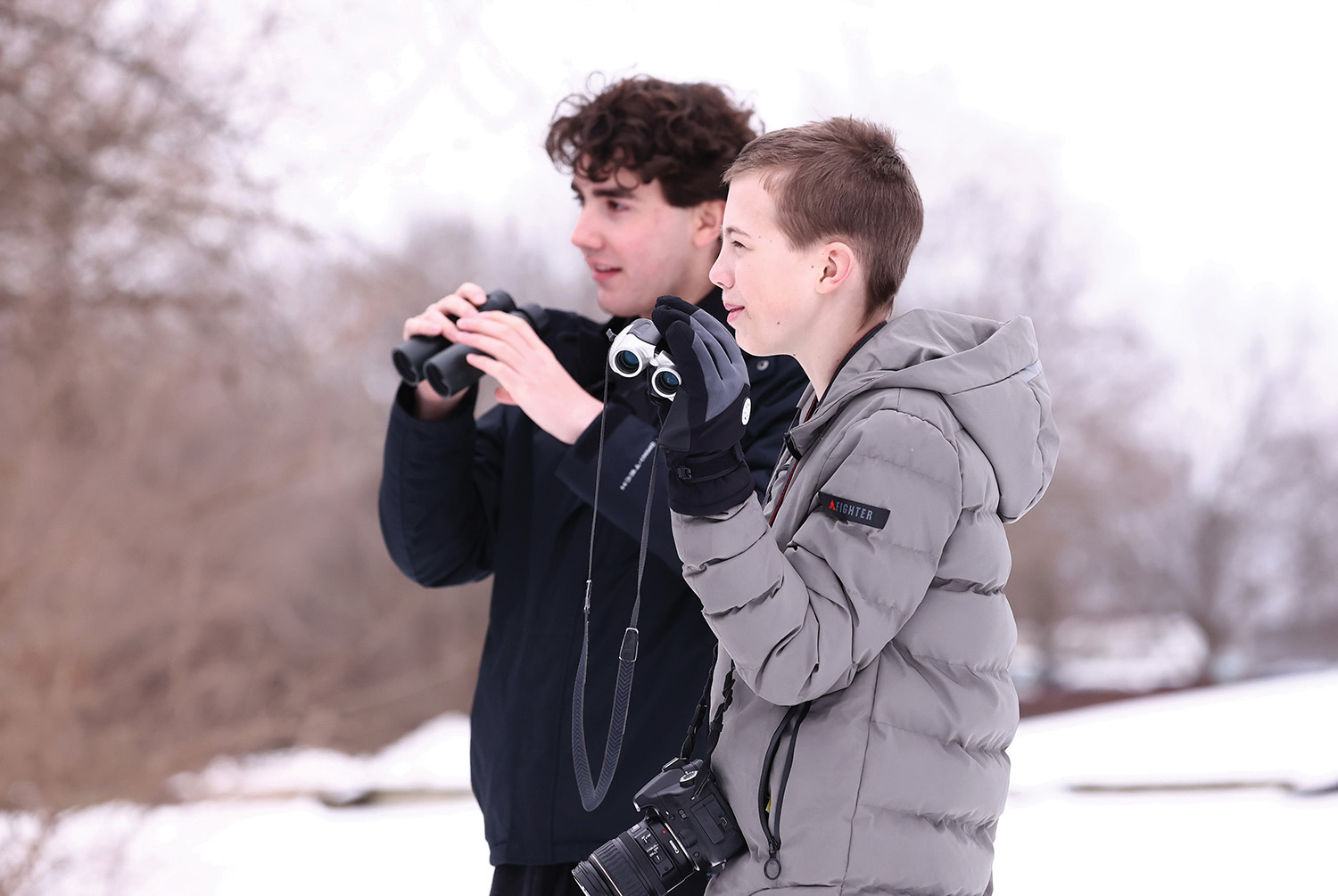
If you surveyed a sampling of American adults, many might divulge that their current career has no roots in childhood dreams. Many high schoolers, in addition, might not have a nailed-down idea of a career forward. Not so for Blacksburg High School senior Xavier Gitre and 13-year-old Caleb Koser of Riner. Passion came easy and fast, and who doesn’t want a career learning about something that fascinates them?
For the two, the galvanizing passion is the world of birds.
Starting Young
Caleb Koser’s interest began in 2019, when a thrift store bird clock became the catalyst for his hobby. The 6-year-old quickly memorized each hour’s bird. When not at home, if he looked at his watch on the hour, he’d reveal what bird was chirping at the moment back at home. Add to the dawning of his bird passion that he lives in a house boasting a wall of floor-to-ceiling windows looking out to a backyard birder’s woodland paradise, and Caleb was hooked.
Xavier Gitre’s story, similarly, starts young – as a 5-year-old, when an intelligent crow traded him a piece of aluminum foil for a cracker. After that followed his first birding trip to the Virginia Tech duck ponds, where a cormorant sighting and a conversation with a fellow birder proved as fodder for his interest.
Caleb’s training began informally. After the fascination with the bird clock, two massive bird books were his food for knowledge. Truly, though, for both of them, the best learning was done by observing. “I remember going to Michigan and seeing several eagles, which were one of my first birds,” Caleb recalls.
Based on a teacher’s encouragement to enter a prestigious competition, Xavier designed an experiment to capture nocturnal flight calls. As a result of his successful experiment, he was listed as one of the top 300 high school researchers in the Regeneron contest.
The chef’s nemesis is the impossible-to-perfect dessert, as the birder’s nemesis is the elusive or hard-to-sight bird. For Xavier, said archnemesis is the purple sandpiper. “It feeds on rock jetties, so every time you’re trying to sight it, you’re about to fall into a freezing ocean,” he laughs. Caleb, similarly, has his eye set on one must-see, the fox sparrow, which has an almost indistinguishable call to the song sparrow, a similar bird.
Blacksburg’s Birding Scene
With the nexus for academics and culture that Blacksburg is, the birding scene in the area is vibrant, supportive and mutual. The top-tier wildlife conservation program at Virginia Tech draws in knowledgeable birders from around the country, and groups like the New River Valley Bird Club offer community and camaraderie. “Everyone is very friendly here,” Xavier says.
Other parts of the country experience birding drama – yes, that’s a thing – and ethical controversies, but Blacksburg offers a different perspective. “The community is tight-knit and unbelievably supportive. Just to illustrate that point, I haven’t ever paid for a pair of binoculars; every pair I’ve ever owned has been a gift,” Xavier comments.
Places that the two cite as their favorites in the area include Pandapas Pond, Claytor Lake, the Virginia Tech Vet School pond, and Radford’s Bisset Park.
Ebird.org is a thriving online community designed for fellow birders to engage with each other and submit checklists that include when and where a certain bird was spotted. Connecting birders through a mutually beloved hobby, it has helped Montgomery County become the birding hotspot that it is.
Birding Beyond Blacksburg
Often, Xavier and Caleb add birding stops along family trips or outings. “We love long road trips, and I often squeeze in some really fantastic birding spots along the way,” Xavier relates. He lists everything from the more typical wildlife refuges and beaches to those more off the beaten path, like sewage treatment plants, strange abandoned buildings and landfills. “I’ve dragged my parents on many adventures, they’ll warn you.” During a trip to Egypt, a unique opportunity included birding on an island in the Red Sea.
Caleb recently visited several national parks in the Pacific Northwest with his family, a hummingbird feeder tucked in his luggage. He got the chance to see two different species of hummers in Washington State, a highlight of the trip. A grove in Redwood National Park was a unique experience, and the best birding of the trip was in Olympic National Park, a temperate rain forest boasting about 300 species of birds. All in all, the West Coast trip enabled Caleb to add 40 new species – “lifers,” in birding terminology – to his life list.
Xavier plans to study at Cornell University beginning this fall, majoring in Environment and Sustainability. After high school, Caleb hopes to become an ornithologist, with specific interests in population and bird behavior. He also has his eye on Cornell, renowned for its Cornell Lab of Ornithology.
When asked what advice he has for the aspiring birder, Xavier notes three important steps. “Get in touch with an experienced birder, have a good field guide, and bird as much as possible.” Book knowledge is significant and vital, but curiosity starts with real-world experience. Caleb echoes this advice. “You don’t need a lot of high-tech equipment, just your eyes and ears.”
Their two stories parallel – learn a lot, make connections, and spend as much time in the field as possible. The lines between hobby and school blur together for these young men. With the birding scene alive and hopping in Blacksburg, and plenty of opportunities for birding in the New River Valley, there’s no time like the present to pick up birding for a new hobby. Most likely, you’ll meet Caleb and Xavier along the way.
Text by Caitlyn Koser
Photos by Jon Fleming
Caitlyn Koser is a homeschool student, freelance writer and Caleb’s sister. She is increasingly tagging along as he requests stops at birding spots in the New River Valley. Consider her the “wing girl”, assisting in spotting.
